Businesses do not lose speed due to lack of talent in people. The real cause of losing speed is that teams still waste too much time moving data, checking routine entries, copying information between systems, and repeating the same low value steps all day. That is exactly the reason that “how robotic process automation works” has developed such an important topic for growing companies. The global robotic process automation market was reckoned at $4.68 billion in 2025 and is predicted to reach $35.84 billion by 2033, while Deloitte realized that 74% of surveyed organizations were already implementing RPA. For many decision-makers, the question is not whether automation is important. The genuine question is how it actually works inside a live business process. Once that becomes clear, RPA no longer sounds like a buzzword; instead, it starts looking like a practical growth tool.
What Is Robotics Process Automation?
Before explaining how robotic process automation works, it is helpful to answer a related question: What is Robotics Process Automation? In simple words, RPA uses software ‘bots’ to perform structured, repetitive digital tasks that humans generally do through screens, systems, forms, emails, and databases. These bots do not substitute strategy or judgment. They follow rules, kick off actions, move data, and complete repetitive steps quicker and more consistently. Microsoft describes RPA as a way to establish and scale attended and unattended automations, while IBM also differentiates between types of bots based on whether the human stays involved during execution.
That is why “How does RPA work” is such a practical business question. RPA functions by mimicking the digital actions a user performs. A bot can log in, open applications, read fields, copy records, authenticate rules, activate follow-up actions, and generate outputs. These actions are based on workflows, conditions, and pre-set logic. In the right environment, it becomes a consistent digital workforce for repetitive processes.
How Robotic Process Automation Works in Simple Terms
At its core, how robotic process automation works is not tough to grasp. A business first recognizes a repetitive process, that process is then mapped into clear steps, and after that, developers or automation professionals configure a bot to follow those steps exactly.
A simple workflow frequently looks like this:
- A trigger starts the process
- The bot opens the required system
- It reads or receives input data
- It applies rules and validations
- It completes the task
- It updates records
- It creates a log, report, or alert
This is the reason that RPA is often used for invoice entry, payroll support, customer onboarding, claims processing, order updates, and report generation. Microsoft documents that attended automation implies human interaction, while unattended automation runs in the background with little or no direct user action.
The value becomes clear when a company scales the same activity hundreds or thousands of times. McKinsey has projected that activities consuming 45% of employee time could be automated using presently demonstrated technology. That does not imply that every role disappears. It implies that many routine steps inside those roles can be automated, sparing people more time for analysis, service, and decision-making.
The Core Components Behind How Robotic Process Automation Works
To understand how robotic process automation works, it is helpful to break the system into its main components.
Process Discovery
Automation begins with process discovery. This is where a company analyses which workflow is repetitive, rule-based, high-volume, and stable adequate for automation. If some process changes every day or depends strongly on human judgment, it should not be considered as the best first candidate.
Strong RPA programs usually start with tasks like data entry, reconciliation, form management, system-to-system transfer, and routine notifications. Deloitte’s research indicates that RPA has already reached mainstream adoption across many organizations, which exhibits how widely companies now use it for these structured workflows.
Workflow Mapping
After deciding the process, the business maps every step. This consists of inputs, outputs, rules, exceptions, approvals, and timing. Workflow mapping concerns because bots need accurate instructions. If the process is messy, the bot will only automate the mess rapidly.
This is the stage where many companies finally confirm how robotic process automation works depend on clarity. RPA is powerful, but it functions well when the underlying workflow is clearly defined.
Bots
Active workers in the automation environment are the bots. The functions they perform include clicks, reads, data transfers, and responses. UiPath and Microsoft both designate RPA platforms as supporting attended and unattended execution models, and that difference is central to deployment strategy.
An attended bot usually assists a human in real time. For example, a support agent may click one button, and the bot gathers customer data from numerous systems. An unattended bot runs on its own, regularly on a schedule or as part of a background procedure. IBM explains that attended and unattended automation serve different operational requirements, and Microsoft similarly defines unattended scenarios as fully automated flows that run on behalf of a user.
Rules and Logic
Bots require instructions. These instructions tell them what to do, when to do it, and what conditions should be met before moving forward. Rules can include things like:
- If an invoice amount exceeds the limit, send it for authorization
- If customer data is incomplete, generate an exception
- If a form is valid, send it to the next system
- If a login fails, produce an alert
This is the rule engine layer of RPA. It is one of the main reasons that businesses ask How does RPA work in such real terms. It works because repetitive logic may be captured and repeated without fatigue.
Integrations
A major reason that RPA grows rapidly is that it can work across current tools. Businesses can use bots to join older applications, web portals, spreadsheets, internal software, CRMs, ERPs, and email workflows rather than replacing every system. Microsoft emphasizes automation across cloud, desktop, and hosted environments, which is one reason that RPA is often attractive to companies with mixed technology stacks.
Monitoring and Reporting
A serious automation setup does not stop after deployment. It follows activities, tracks failures, measures completion times, and files exceptions. This is how companies know whether the automation is working and where it needs enhancement.
Monitoring is also important for security, governance, and continuity of business. NIST mentions that automation can make control and monitoring more feasible and affordable by enabling more repeated and comprehensive data collection.
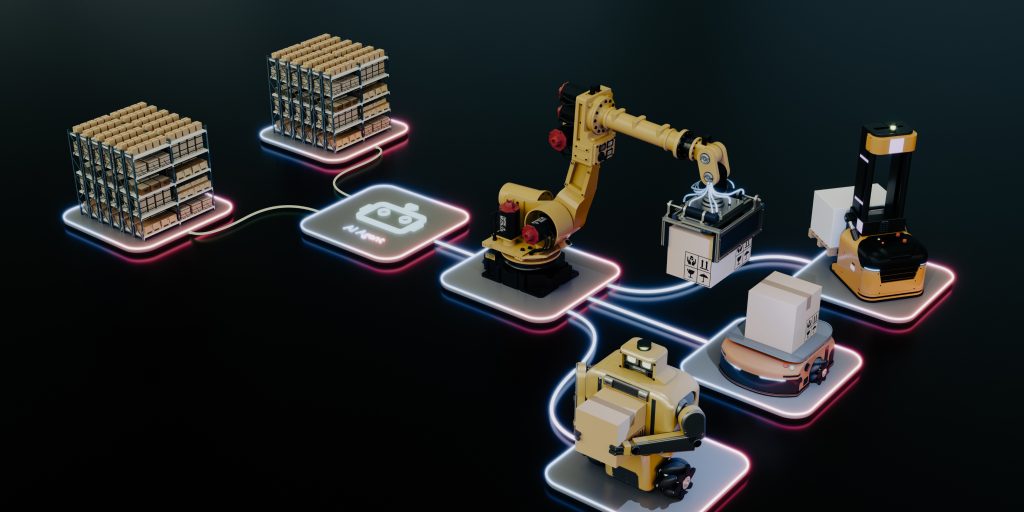
How Does RPA Work in a Real Business Example?
Suppose a finance team that receives hundreds of suppliers’ invoices every week. In the absence of automation, staff open emails, download files, read values, type figures into the accounting system, confirm purchase order numbers, route approvals, and update status sheets.
Now employ how robotic process automation works to that same workflow.
Robots can perform following actions:
- The bot monitors the inbox.
- It downloads invoice attachments.
- It extracts required fields.
- It checks those fields against rules.
- It compares purchase order data.
- It enters approved records into the accounting system.
- It flags exceptions.
- It sends alerts when review is needed.
- It logs every action for reporting.
The same rule acts in HR onboarding, insurance claims, customer support ticket routing, order processing, and compliance checks. Microsoft’s guidance on attended and unattended scenarios demonstrates how organizations can decide between human-assisted automation and fully autonomous background execution depending on the workflow.
Where RPA Delivers the Most Value
The strongest value typically occurs when a process is high-volume, repetitive, time-sensitive, and rule-driven. This explains that how robotic process automation works is most important in operational functions.
RPA often provides value in these areas:
- Finance and accounting
- Customer support
- HR administration
- Procurement operations
- Data migration
- Reporting and compliance
- Order and inventory workflows
The business case is also proved by market momentum. Grand View Research expects strong RPA growth through 2033, and Microsoft’s 2025 Work Trend reporting shows that 80% of employees say they lack the time or energy to do their work, which strengthens the need for systems that remove manual friction.
Where Deep Learning Development Services Fit In
RPA is powerful, but it is usually at its best when the process is organized. When documents are messy, language is unstructured, or decisions depend on pattern recognition, companies often chain automation with AI. That is where deep learning development services can improve value.
For example, RPA can move documents through a workflow, while deep learning models can catalogue those documents, extract meaning, or identify anomalies. In this setup, RPA handles the execution layer, and AI improves the intelligence layer. McKinsey’s 2025 workplace research shows that companies are extensively investing in AI, even though only a small share think themselves mature in deployment.
For businesses planning long-term revolution, this combination is often more powerful than automation alone.
Why Offshore Robotic Process Automation Services Are Growing
Many businesses comprehend how robotic process automation works, but they do not have internal competence to build and maintain everything on their own. That is one reason demand keeps increasing for offshore robotic process automation services and offshore robotic process automation solutions.
Companies often select offshore delivery when they require:
- Quicker implementation
- Lesser operational cost
- Access to specialized automation talent
- Scalable project support
- Flexible delivery models
This is also why firms increasingly hire offshore IT staff or benefit from “on demand dedicated development teams” for automation roadmaps. The right offshore model delivers businesses approach to RPA developers, QA support, workflow analysts, cloud experts, and AI engineers without carrying the full cost of a large permanent local team.
Why IMS Is a Strong Partner for Automation Growth
The first step is understanding how robotic process automation works. The bigger challenge is creating the right workflow, securing the environment, combining with existing systems, and scaling with certainty.
That is where Innovation M Services stands out for support. IMS is positioned as a trusted private cloud provider and technology partner that facilitates businesses move from manual operations to secure, scalable automation. Whether a company wants offshore robotic process automation services, offshore robotic process automation solutions, deep learning development services, or on demand dedicated development teams, IMS delivers the structure required to build, deploy, and improve automation with business goals in mind.
For companies that want to hire offshore IT staff without losing control over quality or security, IMS provides a rational path to scale.
Conclusion
The reason how robotic process automation works is so significant is simple. It shows businesses how to transform repetitive digital work into a controlled, measurable workflow conducted by software bots. RPA begins with process discovery, grows through workflow mapping and rules, and delivers value through bots, combinations, monitoring, and continuous expansion. It becomes more than a tool when combined with the right team and the right infrastructure. It converts into a growth engine.
For businesses ready to modernize operations, Innovation M Services provides delivery strength, offshore support, and secure cloud-first mindset considered necessary to make automation work in the real world. Companies looking for a trusted private cloud provider, consistent RPA execution, and scalable technical support can link with IMS to build the next stage of digital efficiency.