Agriculture Software Development Company
Innovation M Services (IMS) is an Agriculture Software Development Company creating secure, scalable platforms for farms, agribusinesses, cooperatives, and AgriTech product teams. IMS helps agriculture operations in replacement of manual logs with real-time visibility, decrease waste through better planning, and enhance traceability across the supply chain. With a private-cloud mindset and security-first delivery, IMS develops systems that stay trustworthy as seasons, users, and data volumes grow.
Fragmentation
The Agriculture Ops Challenge
Agriculture operations repeatedly run on disconnected tools, which leads to issues like; field data lives in notebooks, inventory is traced in spreadsheets, and maintenance of equipment is reactive. Planning decisions depend on incomplete visibility. When the busy season starts, reporting starts delayed, and that leads teams to lose control over costs, input, and timelines.
Traceability is another factor that adds pressure to many agribusinesses. Buyers demand transparency and teams require reliable lot and batch tracking. Compliance reporting should be easy, and not so hard. If the data layer is fragmented, the result is that every audit, export requirement, and operational decision becomes slow and risky.

Overview
Agriculture Software Development Company Approach
IMS develops with a private-cloud provider mindset. Access control and roles are planned at an early stage. Data is managed in a privacy-aware way. Systems are designed to be scalable with expanding fields, users, and operations. Incorporations are regarded as first-class needs so your software can link with existing supply chain and business systems.
Agriculture Software Development Services
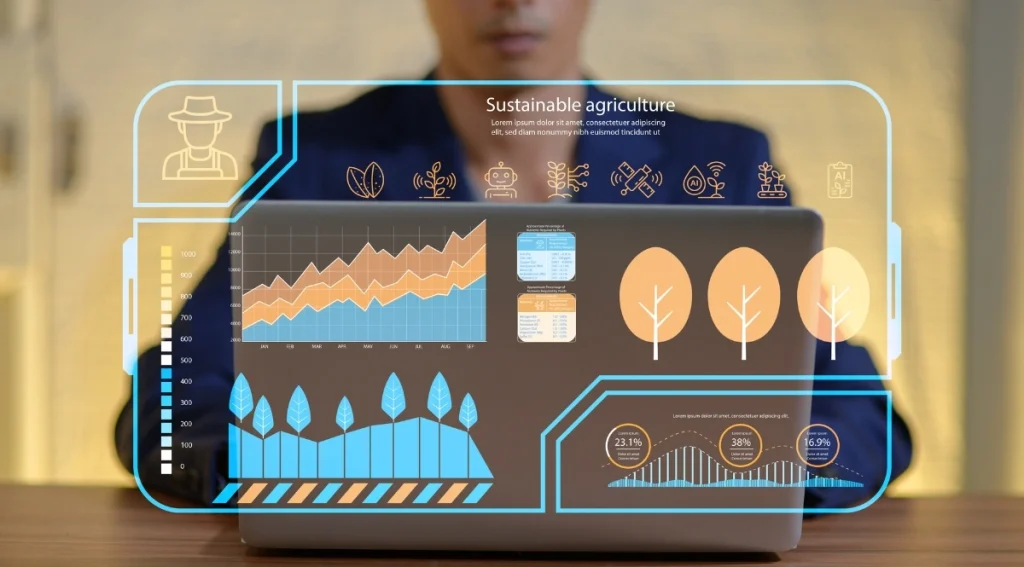
IMS offers agriculture software development services across web, mobile, and backend systems. Farm management platforms can support planning, jobs, field logs, and seasonal workflows so that teams can standardize performance and decrease manual reporting. Crop and input tracking can be controlled at a high level to establish better visibility in usage, timing, and operational costs.
IMS develops inventory and procurement workflows to decrease waste and prevent stockouts. Equipment maintenance modules can help teams in planning preventive schedules, tracking breakdowns, and managing parts and service records. Traceability is supported through lot and batch tracking at a high level, assuring reliable records from production through processing and distribution.
Where data requires to be enriched, IMS supports weather and sensor combinations at a high level, helping teams turn readings into alerts and actionable insights. Dashboards and analytics support for making decisions on yield visibility, efficiency, and operational performance. Mobile apps enable field teams to capture updates rapidly, and combinations connect agriculture platforms with ERPs, marketplaces, and supply chain tools.
IT Solutions for Agriculture
Modern IT solutions for agriculture have their focus on clarity and speed. IMS centralizes data so that teams stop chasing updates across tools and WhatsApp threads. Automation decreases manual steps in procurement, reporting, and approvals. Dashboards present a single operational view for managers, enabling quick decisions that are based on current information.
IMS also focuses on controlled collaboration. Different teams and partners often require different visibility. With a private-cloud mindset, IT solutions for agriculture can be developed with role-based access and audit-friendly activity visibility at a high level, making operations more predictable and accountable.
Why Choose IMS
IMS also delivers a private-cloud mindset to agriculture platforms, which means controlled access, stable deployments, and security-first delivery practices that are designed to protect operational data. IMS stands out prominently through transparent communication, integration-ready design, and scalable architecture developed for real growth.

Role of AI in Agriculture
Innovation M Services (IMS) leverages AI not just for data collection, but to transform raw field signals into predictive power. Within the IMS framework, AI serves as the “brain” of the operation:
- Forecasting & Anomaly Discovery: IMS provides high-level AI services to predict yield outcomes and identify operational anomalies—such as crop disease or equipment failure—before they become costly.
- Predictive Maintenance: Instead of reactive repairs, AI modules analyze equipment data to plan preventive maintenance schedules, ensuring machinery is ready for peak season.
- Intelligent Resource Planning: AI helps teams transition from “raw data” to “structured insights,” aligning information with critical workflows like input planning and labor coordination.

How IMS resolves Agriculture Industry issues with smart, automated tools (end-to-end ecosystem)
Agriculture becomes easier when tools in the field are connected to one platform that can sense, decide, and act. IMS builds smart agriculture systems where weather + sensor signals become alerts and actionable insights, and those insights align with real workflows like irrigation scheduling and input planning.
IMS does not position “smart” as a buzzword. The focus stays on practical improvements: better visibility, earlier issue detection, and decision support that decreases waste and improves productivity.
Smart tools IMS can enable through software + integration
Smart drip irrigation & fertigation (automation-first). IMS can connect moisture readings, crop stage rules, and weather inputs to irrigation schedules, so water is applied only where and when it is needed—then track results through dashboards and analytics.
Drone-assisted field monitoring (scouting at scale). IMS can integrate drone imagery pipelines into the same system used by operations teams, so crop stress and variability are flagged quickly and assigned as tasks—without slowing down field execution.
Greenhouse temperature & humidity management (stable crop conditions). IMS can connect greenhouse sensors and controllers to alerts and automation rules, reducing crop stress and improving consistency in quality while lowering water-heavy correction cycles.
Fertilizer automation & input optimization (less waste, better yield quality). IMS aligns nutrient planning with input tracking and field workflows, so teams apply the right input at the right time, and decisions stay measurable and auditable through a centralized platform.
How IMS delivers this ecosystem (disciplined, secure, scalable)
IMS designs clear UX for field use, builds iterative releases with repeated validation, and embeds QA and security checks throughout delivery—then deploys with monitoring and continuous improvement as the platform evolves.
IMS also centralizes data so teams stop chasing updates across tools and threads, and automation reduces manual steps where it slows operations down.
“Save Water for Mankind” — how IMS proposes smart agriculture solutions that protect water and improve crop quality
“Save Water for Mankind” is a water-first promise, and smart agriculture makes it achievable when decisions are based on real signals. IMS supports weather and sensor combinations that help teams convert readings into alerts and actionable insights, so irrigation becomes controlled, measurable, and repeatable—not guesswork.
IMS’s model is to build an ecosystem that improves the farmer’s daily life by reducing manual effort and uncertainty. Smart agriculture software becomes valuable when it turns signals into structured insights aligned with what teams actually do—irrigation scheduling, equipment monitoring, and input planning—so water use improves while crop quality becomes more consistent.
This is how the slogan translates into outcomes:
- Save water through precision irrigation logic and sensor-driven triggers.
- Improve crop quality through stable greenhouse conditions and better nutrient timing.
- Make farming easier by replacing scattered updates with dashboards, alerts, and automation that reduce daily operational friction.
IMS also keeps delivery realistic—starting with one high-impact use case and expanding in phases—so adoption stays easy while value shows early.
If you want, I can also convert these into two “ready-to-paste” website sections with:
- a 2–3 line intro,
- 4 smart-tool cards,
- and a short “Why IMS” block matching your page’s exact CTA labels and style.
IT Solutions for Agriculture
Every agriculture operation has its own realism. That is the reason that custom software development for agriculture industry offers better adoption and better outcomes than generic platforms. IMS develops software that matches your farm structure, your reporting requirements, and your business model, no matter whether you operate as a farm group, a cooperative, a processor, a distributor, or an exporter.
IMS also supports phased development. To begin, teams can start with one high-impact workflow like field reporting, inventory control, or traceability, and then expand modules over time. With custom software development for agriculture industry, enhancement becomes considerable, not disrupting.
Agriculture App Development Company
Focus of IMS is also on performance and usability because field tools should work under real conditions. The result is a mobile experience that decreases delays, improves reporting quality, and increases operational reliability.

Farming Software Solutions
For agribusiness operations beyond the farm gate, farming software solutions can also support traceability, inventory visibility, and supply chain reporting so stakeholders can trust the data and act rapidly.

Smart Agriculture Solutions
Smart agriculture software becomes precious when it changes signals into action. IMS supports smart features at a high level, containing sensor and IoT combinations, alerts, and analytics that help teams respond immediately. Rather than raw data, teams receive structured insights that is aligned with workflows such as irrigation scheduling, equipment monitoring, and input planning.
IMS approaches “smart” features cautiously to prevent overpromising. The focus remains on practical improvements i.e. better visibility, earlier finding of issues, and decision support that decreases waste and improves productivity.

Key Features
Key Features
Farm planning, job assignment, and field activity logs
Input and inventory tracing with approval workflows
Planning maintenance of equipment and service records
Lot and batch traceability support (high level)
Mobile field apps with role-based access
Dashboards for yield visibility and productivity tracking
Integration-ready architecture for ERP and supply chain tools
Business Benefits
Operational Control Across Farms
Reliable operational control across farms and teams
Reduced Waste
Decreased waste through smarter planning and visibility
Fast Field Reporting
Fast field reporting with less manual records
End-to-End Traceability
Enhanced traceability for buyers and internal governance
Accurate Cost & Inventory Tracking
Team Accountability
Higher team accountability through structured workflows
Season-Ready Scalability
Scalable systems that grow with seasons and users
Low-Maintenance Architecture
Less long-term maintenance through clean architecture
Improve farm visibility and decrease waste; book a 30-minute AgriTech roadmap call with IMS
Trusted Software Outsourcing Since 2020
Expert Teams, Affordable Solutions
STAFF AUGMENTATION
01
TAAS (dedicated resource)
02
Dedicated Teams
When you hire a dedicated team, you’re building an extension of your in-house staff—without the overhead. This team works exclusively for your project, following your workflows, tools, and culture. Unlike freelancers or temporary contractors, a dedicated team provides consistency, accountability, and long-term value. According to Statista (2023), the global outsourcing market is projected to reach $512 billion by 2030, highlighting how businesses worldwide are adopting flexible models like dedicated teams to stay competitive. It’s the perfect model for startups, growing businesses, and enterprises that want to focus on innovation while leaving the technical execution to trusted experts.
03
Project Outsourcing
Project management outsourcing is the practice of handing over the planning, execution, and delivery of projects to external professionals. You gain access to specialized professionals who focus totally on delivering your project’s success instead of stretching your in-house team thin. According to Statista (2023), the global outsourcing market surpassed $460 billion, with project-based outsourcing becoming one of the rapid growing models. The reason is simple as businesses want foreseeable outcomes without the overhead of full-time hires. Outsourcing your project with IM Services means that you have predictable timelines, lower risks, and guaranteed results.
04
Solutions for Startups
Startups face exceptional challenges, i.e. rapid scaling, competition with established players, and tight funding restraints. Even great ideas can fail without the right technology backbone. According to a report by CB Insights (2023), 38% of startups fail due to running out of cash and 20% fail due to lack of proper technology or product-market fit. Choosing the right managed IT services for startups can cover both aspects (funding constraint and improper technology) and make the difference between success and failure. IM Services ensures your startup has trustworthy, scalable, and cost-efficient IT solutions so you can focus on building your business.
05
Solutions for Enterprises
Enterprise organizations operate on a scale. Therefore, they need IT that can handle global operations, ensure compliance, and support business-critical functions 24/7. If you don’t have the right infrastructure, inefficiencies and risks can deteriorate quickly. According to Gartner (2023), global IT spending is likely to reach $5.1 trillion, with enterprises driving the bulk of this growth through investments in cloud, cybersecurity, and managed services. IM Services enables enterprises to unlock innovation while controlling costs and offering scalable solutions that keep pace with evolving demands.
06
Solutions for Small Businesses
07
Engage the Right Talent
Whether you need staff augmentation, TaaS, dedicated teams, or full project outsourcing, our experts help you select the most efficient, scalable, and cost-effective model for your business goals.
STAFF AUGMENTATION
01
TAAS (dedicated resource)
02
Dedicated Teams
When you hire a dedicated team, you’re building an extension of your in-house staff—without the overhead. This team works exclusively for your project, following your workflows, tools, and culture. Unlike freelancers or temporary contractors, a dedicated team provides consistency, accountability, and long-term value. According to Statista (2023), the global outsourcing market is projected to reach $512 billion by 2030, highlighting how businesses worldwide are adopting flexible models like dedicated teams to stay competitive. It’s the perfect model for startups, growing businesses, and enterprises that want to focus on innovation while leaving the technical execution to trusted experts.
03
Project Outsourcing
Project management outsourcing is the practice of handing over the planning, execution, and delivery of projects to external professionals. You gain access to specialized professionals who focus totally on delivering your project’s success instead of stretching your in-house team thin. According to Statista (2023), the global outsourcing market surpassed $460 billion, with project-based outsourcing becoming one of the rapid growing models. The reason is simple as businesses want foreseeable outcomes without the overhead of full-time hires. Outsourcing your project with IM Services means that you have predictable timelines, lower risks, and guaranteed results.
04
Solutions for Startups
Startups face exceptional challenges, i.e. rapid scaling, competition with established players, and tight funding restraints. Even great ideas can fail without the right technology backbone. According to a report by CB Insights (2023), 38% of startups fail due to running out of cash and 20% fail due to lack of proper technology or product-market fit. Choosing the right managed IT services for startups can cover both aspects (funding constraint and improper technology) and make the difference between success and failure. IM Services ensures your startup has trustworthy, scalable, and cost-efficient IT solutions so you can focus on building your business.
05
Solutions for Enterprises
Enterprise organizations operate on a scale. Therefore, they need IT that can handle global operations, ensure compliance, and support business-critical functions 24/7. If you don’t have the right infrastructure, inefficiencies and risks can deteriorate quickly. According to Gartner (2023), global IT spending is likely to reach $5.1 trillion, with enterprises driving the bulk of this growth through investments in cloud, cybersecurity, and managed services. IM Services enables enterprises to unlock innovation while controlling costs and offering scalable solutions that keep pace with evolving demands.
06
Solutions for Small Businesses
07
Engage the Right Talent
Whether you need staff augmentation, TaaS, dedicated teams, or full project outsourcing, our experts help you select the most efficient, scalable, and cost-effective model for your business goals.
Process
Process of Working
IMS begins with discovery and requirements alignment, with focus on subscriber journeys, operational workflows, and integration points. Then Architecture outlines how events, APIs, and data models will behave under real traffic and real dependencies. UX is designed for clarity, speed, and low support friction.
Development follows an iterative method with repeated validation. QA and security checks are rooted throughout to decrease release risk. Deployment is planned for consistency, followed by monitoring support and continuous improvement as the platform evolves.
02
Related Services
IMS supports agriculture platforms end-to-end through:
- custom web development for dashboards and portals,
- mobile app development for field operations, and
- cloud & DevOps for stable deployments.
Cybersecurity and application security testing reinforces access control and secure data control.
IMS also provides data engineering and AI services for forecasting and anomaly discovery at a high level, plus UI/UX design to increase adoption and decrease training time. Where it is useful, IMS can also support back-office enablement to streamline reporting and operational processes.

Frequently Asked Questions
Your Questions. Our Expertise.
What does agriculture software development services include?
Agriculture software development services include farm management systems, mobile field apps, inventory and procurement workflows, traceability support, dashboards, and integrations with ERP and supply chain tools.
Can IMS build IT solutions for agriculture for large agribusinesses?
Yes. IMS builds scalable platforms for multi-site operations, role-based access, reporting dashboards, and integration-heavy workflows.
Do you support offline-friendly mobile apps for field teams?
Yes. IMS can design offline-friendly mobile workflows that support capture at a high level and sync when connectivity returns.
Can you build custom software development for agriculture industry workflows?
Yes. IMS develops custom workflows for farms, cooperatives, processors, distributors, and exporters, aligned to your operational model.
What is smart agriculture software in practical terms?
It usually incorporates sensor and weather integrations, alerts, and analytics that help teams respond faster and plan resources more efficiently.
Can you support traceability and lot tracking?
Yes. IMS supports lot and batch traceability at a high level, helping teams improve record reliability and supply chain transparency.
What is the role of AI in agriculture today?
AI acts as the decision-support layer that helps farms move from manual logs to real-time visibility, smarter planning, and stronger control. IMS focuses on practical AI value—alerts, analytics, and dashboards that help teams act on current conditions instead of delayed reporting.
How does AI help improve crop quality and productivity?
Crop quality improves when field signals are converted into actions that teams can execute consistently. IMS aligns insights with workflows such as irrigation scheduling, equipment monitoring, and input planning—supported by dashboards for yield visibility and productivity tracking.
What challenges does AI help solve in agriculture operations?
AI reduces delays and fragmentation by centralizing operational signals into a single, decision-ready view. This supports better control over costs, inputs, and timelines, especially when farms are managing activity across teams, sites, and seasons.
Can IMS support smart drip irrigation and fertigation automation?
Yes. IMS supports weather and sensor combinations that turn readings into alerts and actionable insights. These insights guide irrigation scheduling in a controlled and measurable way, supporting precision watering outcomes and reduced water waste.
Can IMS enable automated fertilizer tools and input optimization?
IMS builds systems where crop and input tracking improves visibility into usage, timing, and costs. When paired with insights aligned with input planning, teams can reduce waste and execute fertilizer strategies more consistently across seasons.
Can IMS connect drones, greenhouse sensors, and field equipment into one ecosystem?
IMS builds integration-ready platforms that can link with existing business systems and supply chain workflows. This allows smart tools—such as greenhouse sensors or drone monitoring workflows—to be unified into one operational view instead of scattered tools and updates.
What does “Save Water for Mankind” mean in practical implementation?
It means shifting water decisions from guesswork to signal-based control. IMS enables actionable alerts from weather and sensor inputs so irrigation scheduling becomes measurable, repeatable, and aligned with daily execution—reducing water waste without disrupting productivity.
Which engagement model is best for modernization?
TaaS and dedicated product teams work best for phased modernization. Fixed scope is perfect for a defined module. Staff augmentation works well when you require rapid capacity.
Agriculture Software Built for Visibility, Speed & Scale
Agriculture operations become convincing when data is timely, workflows are organized, and decisions are faster. IMS builds platforms that enhance visibility, decrease waste, and scale reliably. If you require an Agriculture Software Development Company with a private-cloud mindset and disciplined delivery, Innovation M Services is ready to help.