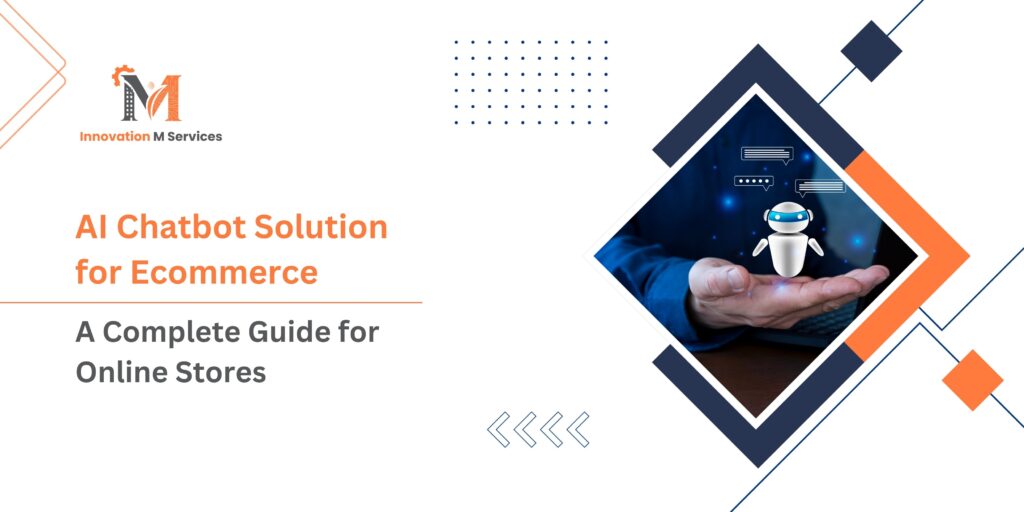
Online stores lose sales when small questions become large delays. A shopper may need to compare products, confirm delivery, understand a return rule, or locate an order late at night. If the answer is buried in menus or waits for business hours, buying intent can disappear. An ai chatbot solution for ecommerce gives retailers a conversational layer that can answer, recommend, retrieve information, and route customers instantly. Adobe Digital Insights reported that traffic to U.S. retail sites from generative AI tools increased 693.4% year over year during the 2025 holiday season, showing that conversational discovery is becoming a practical commerce channel today.
What Is an AI Chatbot Solution for Ecommerce?
An ai chatbot solution for ecommerce uses natural-language processing, machine learning, large language models, rules, or a combination of them to interact with shoppers. A modern bot can understand intent, retrieve approved information, connect with commerce systems, complete permitted actions, and transfer complex cases to people.
Quick Answer: What Can an Ecommerce AI Chatbot Do?
A conversational AI chatbot solution for ecommerce can support product discovery, comparisons, availability questions, delivery information, returns, order updates, and human escalation. A customer service AI chatbot solution for ecommerce focuses more on post-purchase support, while sales assistants emphasize recommendations, bundles, lead capture, and conversion.
The strongest systems combine verified knowledge, live APIs, permissions, rules, and fallbacks. Generative AI for chatbot development must remain grounded in current commerce data.
Ecommerce Chatbot Versus Live Chat
Live chat depends on an available employee. Rules-based bots follow predefined paths. Generative bots interpret varied wording and compose responses from context. Hybrid systems combine automation with human judgment.
The practical test
A chatbot creates value when it reduces customer effort without hiding the route to a person. It should know what it can answer, what it must verify, and when it should stop.
Benefits of Ecommerce AI Chatbots
Salesforce reported in May 2026 that 66% of customer service organizations use AI agents, up from 39% in 2025, and 70% reported measurable value within 60 days. Adobe found that 2025 U.S. holiday shoppers arriving from generative AI referrals spent 45% more time on retail sites and viewed 13% more pages. These trends highlight how offshore outsourcing solutions can help businesses access specialized AI expertise and scale customer-focused technology initiatives efficiently.
For retailers, benefits can include:
- 24/7 answers for product, delivery, return, and account questions.
- Faster handling of repetitive order-status and availability requests.
- Conversational discovery across large or technical catalogs.
- Qualified lead capture and routing to sales or service teams.
- Recommendations based on approved merchandising rules.
- Support across websites, mobile apps, and messaging channels.
A conversational ai chatbot solution for ecommerce is especially useful when product questions require context. A customer service AI chatbot solution for ecommerce can reduce waiting while preserving escalation for refunds, complaints, payment disputes, fraud concerns, or unusual exceptions.
McKinsey estimates that generative AI applied to customer care could create productivity value equal to 30% to 45% of current customer-care function costs. That is potential, not a promised saving, but it helps explain the investment in automation.
Main Types of Ecommerce AI Chatbots
Rules-Based and Guided Bots
These use buttons, menus, decision trees, and fixed responses. They are predictable for narrow tasks such as policy navigation or lead capture but struggle with unexpected wording.
Retrieval-Grounded Generative Bots
This approach uses generative AI for chatbot development with retrieval-augmented generation, or RAG. The system searches approved product content, policies, and knowledge bases before composing an answer. A conversational ai chatbot solution for ecommerce built this way can answer nuanced questions while staying connected to managed content.
Transactional and Tool-Using Bots
These systems call APIs to retrieve orders, check inventory, create cases, schedule returns, or build carts. A customer service AI chatbot solution for ecommerce often needs tool use because customers expect action, not only explanations. Sensitive actions should require authentication and confirmation.
Enterprise and Omnichannel Assistants
An enterprise AI chatbot development service may connect storefronts, CRMs, help desks, order management, product information, identity, analytics, and messaging. It must also support governance, observability, role-based access, resilience, multilingual behavior, and higher traffic.
AI Chatbot Development Process for Ecommerce
The ai chatbot development process should be treated as product engineering, not as adding a chat widget. Teams researching how to develop an ai chatbot should begin with business workflows and measurable outcomes before choosing a model.
Step 1: Define Use Cases and KPIs
Prioritize high-volume and high-value conversations across sales, service, account, and operations. Measure answer accuracy, task completion, escalation, conversion contribution, satisfaction, and cost.
Step 2: Audit Data and Knowledge
A reliable ai chatbot development process starts with reliable information. Review product specifications, FAQs, shipping rules, returns, warranties, inventory sources, and service transcripts. Remove expired offers and conflicting instructions.
A team learning how to develop an ai chatbot must classify what can be public, what requires authentication, what should be masked, and what should never enter prompts or logs.
Step 3: Select Architecture and Models
Decide whether each use case needs rules, retrieval, an LLM, tool calling, or several components. Generative AI for chatbot development works best when deterministic controls surround the model. Price, stock, and order status should come from authoritative live systems.
For larger retailers, an enterprise AI chatbot development service should define model routing, search, memory, API gateways, identity, audit trails, monitoring, and fallback behavior before coding accelerates.
Step 4: Design Conversations and Escalation
Map normal journeys, unclear questions, failures, escalation triggers, and multilingual behavior. A conversational ai chatbot solution for ecommerce should clearly indicate that it is automated and keep human support accessible.
Step 5: Build Commerce Integrations
Common integrations include Shopify, Shopify Plus, WooCommerce, Adobe Commerce, CRMs, help desks, order-management systems, inventory services, catalogs, loyalty tools, and analytics.
A customer service AI chatbot solution for ecommerce may need authenticated order lookup, ticket creation, and return workflows. Sensitive operations should use server-side authorization and least-privilege permissions.
Step 6: Test Accuracy, Safety, and Actions
Testing should cover common questions, ambiguity, stale content, API failures, permission boundaries, adversarial prompts, and human handoffs. NIST identifies confabulation and data privacy among generative-AI risks. OWASP’s 2025 guidance highlights prompt injection and sensitive-information disclosure.
This is why how to develop an ai chatbot is also a security question. Teams should evaluate expected answers and tool actions before production traffic is allowed.
Step 7: Launch and Improve
The ai chatbot development process continues after release. Monitor unanswered questions, retrieval misses, inaccurate answers, API errors, escalation quality, user feedback, conversion contribution, and operating cost. Update knowledge and guardrails as products and policies change.
Ecommerce AI Chatbot Cost
The cost of an ai chatbot solution for ecommerce depends on the systems behind the interface. Clutch’s AI Pricing Guide, updated September 2, 2026, reports reviewed AI projects commonly range from $10,000 to $49,999 and chatbot companies often list $25 to $49 per hour. Enterprise requirements can push budgets higher.
Major Cost Drivers
- Number and complexity of use cases.
- Catalog size, languages, and knowledge quality.
- Model, RAG, hosting, and inference requirements.
- Ecommerce, CRM, ERP, help-desk, and logistics integrations.
- Authentication, analytics, security, and compliance needs.
- Traffic, latency targets, uptime, and ongoing support.
A narrow pilot may sit near the lower end of common AI project budgets, while a deeply integrated assistant can extend beyond them. An enterprise AI chatbot development service should estimate architecture, integrations, testing, infrastructure, and ongoing operations separately.
Generative AI for chatbot development also creates recurring expenses for model usage, search infrastructure, monitoring, and maintenance. The business case should compare total cost with service, conversion, and customer-experience outcomes.
How to Build Trust and Security
Teams should design for accuracy, transparency, security, and easy human escalation before personality. NIST recommends lifecycle risk management and secure-development practices for generative AI systems.
Reliability Checklist
A strong support chatbot should:
- Retrieve current prices, inventory, policies, and orders from authoritative sources.
- Avoid inventing discounts, delivery promises, warranties, or specifications.
- Authenticate users before exposing account or order data.
- Minimize personal data in prompts and logs.
- Confirm consequential actions before execution.
- Escalate disputes, fraud signals, complaints, and unusual exceptions.
A conversational ai chatbot solution for ecommerce should be tested with real customer language, not only ideal scripts. Generative AI for chatbot development improves flexibility, but flexibility without boundaries can increase operational and security risk.
How to Choose an AI Chatbot Development Company
A provider should understand AI engineering and ecommerce operations. It must explain data flows, failure modes, integrations, security, evaluation, and business measurement.
Questions to Ask
- Which ecommerce and service platforms has the team integrated?
- How are retrieval quality and generated answers evaluated?
- How are prompt injection and data leakage controlled?
- Can the team build RAG, APIs, analytics, and human handoff?
- Who owns the code, prompts, embeddings, data, and deployment assets?
- What support is available after launch?
Organizations that need governance and scale should verify that a vendor offers an enterprise AI chatbot development service rather than only configuration. Teams considering how to develop an ai chatbot should ask for a phased roadmap covering discovery, prototype, controlled pilot, production hardening, and optimization.
Why Innovation M Services for Ecommerce Chatbots
Innovation M Services combines AI development, chatbot engineering, custom ecommerce, web, cloud, and flexible staff augmentation. IMS can therefore treat the bot as part of the commerce stack rather than an isolated widget.
IMS can plan assistants around product discovery, customer support, order workflows, knowledge retrieval, and integrations. Its enterprise AI chatbot development service can support startups, growing stores, and organizations requiring broader architecture and governance.
The IMS AI chatbot development process can cover discovery, conversational design, architecture, development, integration, evaluation, launch, and optimization. Retailers can also hire dedicated specialists through dedicated team augmentation to expand engineering capacity and support ongoing chatbot development and optimization.
Conversion-Focused Next Step
A store considering a customer service AI chatbot solution for ecommerce should begin with its highest-friction conversations and the data required to resolve them. IMS can review those workflows, identify practical opportunities, and recommend a phased implementation.
Conclusion
Ecommerce chatbots now extend beyond FAQs into guided shopping and service resolution. Sustainable value depends on accurate data, safe actions, measurement, and human support.
Innovation M Services can help retailers build an ai chatbot solution for ecommerce that fits their customer journey and technology stack. Businesses ready to reduce service friction, improve product discovery, or automate high-volume conversations can contact IMS for a consultation and phased roadmap.